{"ajaxurl":"https:\/\/models118.co.uk\/wp-admin\/admin-ajax.php","nonce":"40459cb95a","homeUrl":"https:\/\/models118.co.uk\/","shopUrl":"https:\/\/models118.co.uk\/shop\/","collectionLimit":12,"i18n":{"addedToCart":"Added to cart","addedToWishlist":"Added to wishlist","removedFromWishlist":"Removed from wishlist","error":"Something went wrong","loading":"Loading...","outOfStock":"Out of stock","viewCart":"View cart","addedToCollection":"Added to Collection","reserved":"Reserved!","invalidEmail":"Please enter a valid email address","connectionError":"Connection error. Please try again."},"stats":{"models":552,"brands":31,"makers":11,"collectors":10000}}
<h1>Classic WRC Models - Group B to Golden Era Rally Heritage</h1>
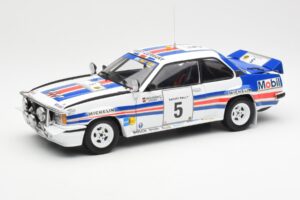
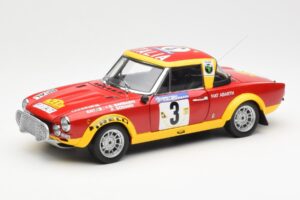
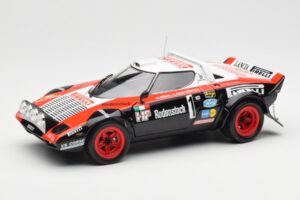
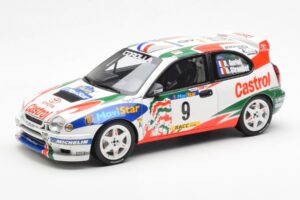
<p>Classic WRC replicas preserve rallying's most celebrated decades, from Group B's unrestricted monsters through the manufacturer warfare that captivated television audiences worldwide. Spanning 1982 through the mid-2000s golden age with Subaru, Mitsubishi, and Lancia factory campaigns, these models from IXO, Trofeu, and Spark capture Colin McRae's spectacular Impreza moments and Richard Burns' championship glory across 1:18 and 1:43 scales.</p>
Browse 1 WRC Classic scale models — diecast and resin from leading manufacturers
What WRC Classic model cars do you offer?
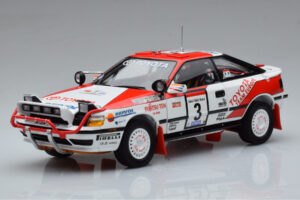
Our WRC Classic collection features 1 diecast and resin scale models across all major scales and price ranges. Featured brands: Toyota. New arrivals added regularly.
Which manufacturers make WRC Classic models?
WRC Classic models are produced by Otto, among others. Each manufacturer brings different strengths — from budget-friendly diecast to hand-finished resin limited editions.
What scales are available for WRC Classic model cars?
WRC Classic models are available in 1:18. The 1:18 scale (25-28 cm) offers the most detail; 1:43 is compact and ideal for larger collections.
Are WRC Classic diecast models collectible?
WRC Classic models are among the most sought-after in the hobby. Limited resin editions (under 3,000 pieces) appreciate after selling out. Key factors: production run size, manufacturer reputation, and the car's status among enthusiasts.
How to choose the best WRC Classic model car?
For WRC Classic models, choose your scale first — 1:18 for display impact, 1:43 for variety. Then compare materials: diecast for hands-on handling, resin for sharper detail. Solido and Norev for value, AUTOart for premium with opening parts.
Are WRC Classic model cars good gifts for car enthusiasts?
WRC Classic diecast models make memorable gifts for car enthusiasts. Choose 1:18 scale for maximum visual impact on the shelf. Look for models with opening parts for interactive display. Norev and Solido offer gift-ready quality in branded manufacturer packaging.
How are model cars shipped?
5-layer packing: original box, bubble wrap, foam inserts, reinforced carton, FRAGILE markings. All shipments tracked and insured. Damage rate under 0.1%.
Do you offer returns?
14-day returns on unused items in original packaging. Defective or damaged in transit? Free replacement — contact us with photos within 48 hours.
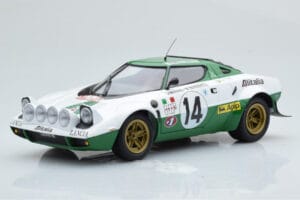
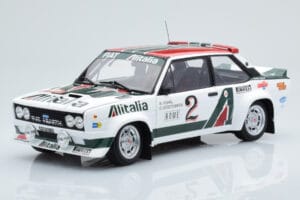
<p>The classic WRC era spans two defining decades of rally history that established the championship as television spectacle and manufacturer battleground, beginning with Group B's 500-horsepower monsters from 1982 through the Group A transition that brought factory-backed Subaru and Mitsubishi campaigns to British television screens through the 1990s and into the 2000s. Colin McRae's 1995 championship victory for Subaru made him Britain's first world rally champion, sparking a golden age of UK interest in international rallying that continued through Richard Burns' 2001 title and beyond. Classic WRC models preserve this heritage through detailed livery reproductions capturing Rothmans Porsche 911 SC RS machines, Martini Lancia Delta Integrales, 555 Subaru Imprezas, and Marlboro Mitsubishi Lancer Evolutions that defined the era's visual identity.</p><h2>Group B Legends and the Transition to Group A Dominance</h2>
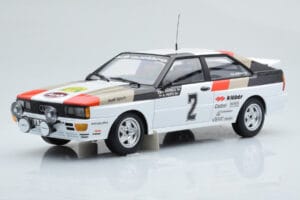
<p>Group B regulations from 1982 to 1986 produced the most spectacular rally machines ever built, unrestricted by power limitations and constructed from lightweight composite materials that enabled incredible power-to-weight ratios. The Audi Quattro pioneered four-wheel-drive supremacy with turbo five-cylinder power, the Peugeot 205 T16 combined mid-engine layout with devastating acceleration, the Lancia Delta S4 pushed twin-charging technology beyond rational limits with both supercharger and turbocharger feeding its engine, and the MG Metro 6R4 represented Britain's attempt at Group B glory with naturally aspirated V6 power. These machines generated over 500 horsepower in qualifying trim and terrorised spectators who stood too close to stage edges, ultimately contributing to the category's cancellation after fatal accidents in 1986 demonstrated these cars had exceeded safe competition parameters for public road events.</p>
<p>The shift to Group A regulations in 1987 fundamentally transformed rally competition from engineering arms race to manufacturer marketing battleground, requiring production-based homologation that tied competition success directly to showroom car credibility.</p>
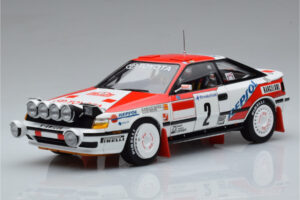
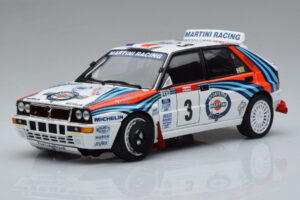
<p>Lancia's Delta Integrale dominated this transition period with six consecutive manufacturers' championships from 1987 through 1992, establishing four-wheel-drive turbocharged performance as the template every subsequent WRC competitor would follow. The Integrale's boxy Italian styling became synonymous with rally dominance, particularly in Martini Racing livery that British television audiences watched winning on gravel in Finland, tarmac in Corsica, and the mixed surfaces of Rally GB. Ford's Sierra and Escort RS Cosworth campaigns maintained British manufacturer interest through this period, while Toyota's Celica GT-Four emerged as the Japanese challenge that would eventually open the door for Subaru and Mitsubishi to transform WRC into the manufacturer warfare that defined the 1990s.</p>
<p>The early 1990s transition saw Lancia's withdrawal from rallying after their unprecedented success, creating the opportunity for new manufacturers to establish dominance. Subaru's entry in 1993 with the Impreza 555 and Mitsubishi's Evolution campaign from 1995 onwards established the manufacturer rivalry that would captivate global audiences and make WRC a mainstream television sport throughout the decade.</p><h2>The WRC Golden Age and British Rally Heroes</h2>
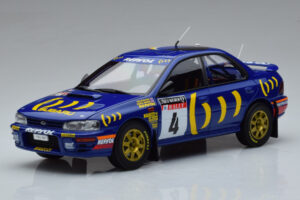
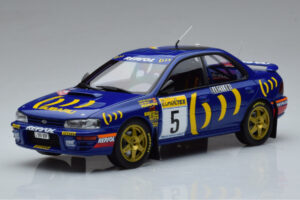
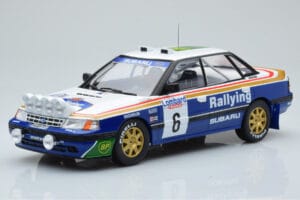
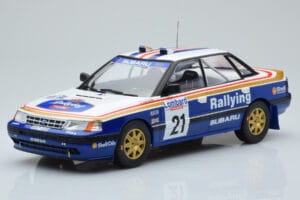
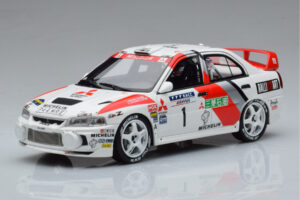
<p>The Subaru versus Mitsubishi rivalry from 1995 through the mid-2000s represents classic WRC's commercial peak, with two Japanese manufacturers investing heavily in European-based factory teams specifically to contest the championship on gravel stages in Finland and Australia, snow banks in Sweden, and tarmac rounds in Corsica. Subaru's 555-liveried Impreza in iconic blue became inseparable from Colin McRae's sideways driving style, while Mitsubishi's red and white Lancer Evolutions represented technical precision under Tommi Mäkinen's four consecutive championships from 1996 to 1999. These machines appeared production-based enough that enthusiasts could buy near-identical road versions from dealers, yet sophisticated enough with active differentials, anti-lag turbo systems, and competition-spec suspension to dominate the world's most demanding motorsport stages.</p>
<p>British driver achievements during this golden era elevated WRC to mainstream UK sports coverage, with Rally GB becoming a highlight of the autumn sporting calendar as fans lined Welsh forest stages to watch their heroes competing on home territory.</p>
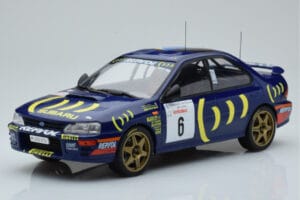
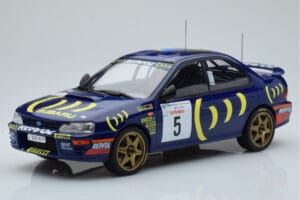
<p>Colin McRae's 1995 championship victory driving for Subaru made him Britain's first world rally champion and established his reputation for spectacular commitment that made him a household name beyond motorsport circles. His "if in doubt, flat out" philosophy produced some of rallying's most memorable moments, from his Impreza's extraordinary jumps on Finnish stages to his ability to extract performance from damaged cars that should have retired. Richard Burns matched McRae's achievement with the 2001 championship driving for Subaru, taking the title through calculated precision rather than spectacular risks, demonstrating Britain could produce champions with different driving philosophies but equal effectiveness. Both drivers' careers are documented extensively through classic WRC model releases, particularly their championship-winning machines and memorable event-specific liveries.</p>
<p>Beyond the British champions, this era produced memorable rivalries and achievements from Carlos Sainz's Corolla victories for Toyota, Marcus Grönholm's Peugeot 206 dominance in the early 2000s, and Sébastien Loeb's emergence with Citroën Xsara that would eventually establish a nine-championship dynasty. Each manufacturer campaign brought distinctive liveries and technical approaches that classic WRC replica producers document systematically, from Ford's Martini-backed Focus RS machines to Peugeot's Total-sponsored campaigns that bridged the golden era into the 2000s.</p><h2>Collecting Classic WRC Rally Models</h2>
<p>Classic WRC model production concentrates among specialist manufacturers who dedicated significant resources to documenting this golden era through systematic event coverage and championship season documentation. IXO and its dedicated RAM sub-brand produce the most extensive classic WRC coverage at accessible price points, systematically documenting complete rally grids for major championship rounds with driver names, co-driver identification, event specification, and sponsor liveries captured through tampo printing processes. Their catalogue covers Group B legends through the entire Subaru-Mitsubishi era, including McRae and Burns championship machines in multiple event liveries that UK collectors prize particularly. Trofeu specialises in classic rally models with particular strength in Group B and early Group A machinery, producing Audi Quattro Sport, Lancia Delta S4, Peugeot 205 T16, and Metro 6R4 replicas in detailed 1:43 scale that serves historic rally enthusiasts.</p>
<p>Scale choice significantly affects classic WRC collecting strategy, with 1:43 enabling comprehensive season documentation where complete championship fields remain practically displayable, while 1:18 suits hero-piece treatment of personally significant moments like McRae's championship year or Burns' title-winning machines.</p>
<p>Spark delivers premium sealed resin classic WRC models with superior paint depth and tampo print resolution particularly beneficial for complex sponsor liveries from the golden era, when tobacco sponsorship created distinctive visual identities that defined each manufacturer's appearance. Minichamps covers selected classic WRC highlights in both 1:18 opening-feature diecast and sealed 1:43 precision, focusing on championship-winning configurations rather than comprehensive event documentation. AUTOart produces definitive 1:18 classic WRC models with opening features for landmark machines including Group B legends and selected championship-winning Subarus, though at premium price points reflecting their hand-built construction standards.</p>
<p>Thematic collecting approaches for classic WRC naturally organise around several strategies that reflect how enthusiasts connect with this era's heritage. Era-focused collections concentrate on specific competitive periods, such as complete Group B manufacturer representations or dedicated Subaru versus Mitsubishi golden-age season sets documenting both factory entries across memorable championship battles. Driver-focused approaches follow individual careers across teams and machinery changes, tracking McRae from Subaru through Ford and Citroën, or documenting Burns' Subaru partnership through his championship-winning years. Event-focused collections concentrate on historically significant runnings of Rally GB, capturing British driver performances on home territory across multiple championship years. Many UK collectors maintain dedicated Colin McRae collections documenting his entire WRC career across multiple manufacturers and event liveries, recognising his status as Britain's most celebrated rally driver.</p>
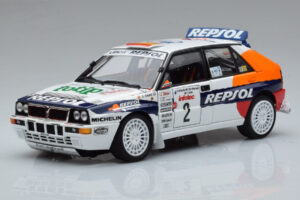
<p>Livery accuracy becomes particularly important for classic WRC collecting since sponsor identities defined this era's visual character. Rothmans, Marlboro, 555, Repsol, Martini, and other tobacco or major corporate sponsors created the distinctive colour schemes that made each manufacturer's factory effort immediately recognisable on television coverage. Model producers who accurately reproduce these complex sponsor graphics with correct logo placement and appropriate colour matching deliver significantly more collecting satisfaction than simplified approximations. Event-specific livery variants also matter greatly, as McRae's 1995 championship-winning Impreza appeared in different sponsor configurations across the season, and dedicated collectors seek these specific event representations rather than generic season models. Rally GB models carry particular significance for UK collectors, representing home event performances where British drivers competed in front of Welsh forest audiences who remain passionate about rallying's golden era decades after the Subaru-Mitsubishi rivalry ended.</p>