Last One
New

You qualify for FREE shipping!
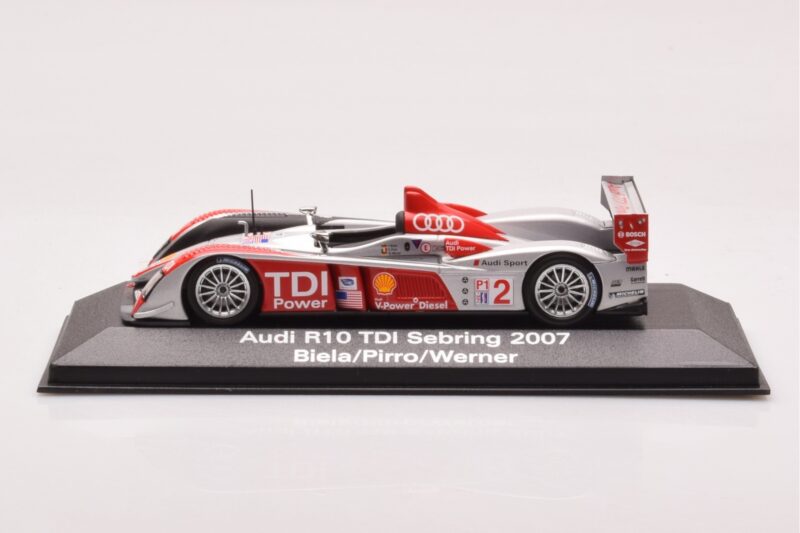
The Audi R10 TDI changed endurance racing's assumptions permanently. When Audi entered Le Mans in 2006 with a turbocharged V12 diesel LMP1 car, most observers expected a principled but compromised performance — fuel economy and torque against petrol power and outright speed. The R10 TDI won outright. It then won Le Mans again in 2007 and 2008, making the diesel argument unanswerable. This Minichamps Audi R10 TDI 1:43 diecast captures a specific moment within that dominant campaign: the #2 entry of Frank Biela, Emanuele Pirro, and Marco Werner at the 2007 12 Hours of Sebring, where Audi extended the diesel programme into North American endurance competition alongside preparations for that year's Le Mans assault.
Minichamps built their 1:43 diecast reputation on systematic motorsport coverage rather than selective hero-car releases. Their approach produces complete race grids — multiple entries from the same event, driver-specific attributions, distinct number configurations — which means a hobbyist can document a single race weekend across its full competitive field rather than settling for a generic season representative or the winning car alone. For an Audi Sport Team Joest programme that regularly deployed three R10 TDI chassis simultaneously across the American Le Mans Series calendar alongside Le Mans preparation, this methodical approach produces exactly the variant range that thorough documentation requires.
The 1:43 scale suits motorsport subjects in ways that larger formats do not always replicate. At approximately 10 centimetres nose to tail, the R10 TDI's elongated LMP1 profile — the low closed cockpit, the pronounced rear diffuser, the curved tail section — reads clearly on a display shelf. Lifting this model from its packaging, the zinc alloy body carries a compact density that gives smaller-format race replicas a satisfying physical quality, heavier than size suggests, lending the kind of solidity that distinguishes proper diecast construction from lightweight injection-moulded alternatives at a similar price point. The Audi Sport livery, with its white body, TDI flank badging, and red-ringed Audi emblem, is reproduced through tampo printing that holds fine detail at 1:43 tolerances without the edge-degradation risks that decal application introduces over years of shelf display.
Where Minichamps competes against Spark's resin alternatives for LMP1 subjects, the distinction lies in subject coverage depth versus surface finish precision. Spark achieves sharper body line definition through sealed resin moulding — their castings hold tighter panel transitions than diecast zinc alloy allows. Minichamps, however, covers more entry-specific variants per event: the different car numbers, driver combinations, and circuit designations that turn a race into a fully documentable moment. For buyers seeking this particular Biela/Pirro/Werner #2 Sebring entry rather than a generic Audi R10 TDI season piece, Minichamps' commitment to race-specific documentation makes them the natural starting point.
The engineering case behind the R10 TDI remains one of endurance racing's most decisive technical arguments. Audi's Ulrich Baretzky led development of the 5.5-litre twin-turbocharged V12 diesel, which produced approximately 650 horsepower alongside torque figures that petrol-powered competitors from Acura and Porsche could not approach at equivalent engine speeds. The diesel's torque characteristic — building strongly from low rpm — proved particularly suited to Sebring's combination of tight infield hairpins and flat-out banked sections, where progressive throttle application from slow corners matters as much as top-end output on the straights.
Fuel economy was the decisive strategic advantage. The R10 TDI completed considerably longer stints between refuelling stops than petrol-powered rivals, and in endurance racing each additional pit stop costs roughly 30 to 45 seconds of track position. Across a 12-hour race at Sebring or 24 hours at Le Mans, the cumulative benefit of fewer fuel stops translates into measurable time advantages that outright pace figures cannot offset. The diesel programme also benefited from compression ignition's characteristic robustness across extended operating cycles and wide temperature ranges — reliability over marathon distance is not a secondary concern when the race lasts longer than most working days.
By 2007, Peugeot had begun fielding the 908 HDi FAP diesel LMP1, establishing the diesel-versus-diesel rivalry that would define the prototype class through Peugeot's withdrawal after 2011. Sebring 2007 was among the early competitive encounters between these programmes — context that positions this Minichamps replica not simply as documentation of a race result, but as a starting point for displaying the whole diesel era's competitive arc from its opening rounds through to Audi's eventual championship dominance.
Sebring International Raceway in Florida is the oldest continuously running sports car race in North America, held annually since 1952. The March calendar slot places the 12-hour event early in the endurance season, giving factory programmes their first major competitive test before Le Mans preparations intensify through the summer. For Audi Sport Team Joest, Sebring served simultaneously as a points-scoring event in the American Le Mans Series and a reliability proving ground for the R10 TDI ahead of the year's most demanding contest.
The driver trio documented on this Minichamps replica brought accumulated Le Mans experience into the #2 car. Frank Biela and Emanuele Pirro had won Le Mans five times together as a pairing — a combination of Biela's metronomic consistency across long stints and Pirro's technical feedback precision that Audi Sport returned to repeatedly across both the R8 and R10 eras. Marco Werner added a further layer of endurance experience to the same entry, creating a driver combination that represented some of the deepest race management knowledge in prototype racing. Their #2 car was Audi's most experience-weighted entry, making it a natural focus for those documenting the programme's most credentialled lineup rather than the sister cars carrying younger driver development programmes.
Minichamps' choice to document this specific #2 entry — with full driver attribution and event designation — rather than producing a generic R10 TDI carrying no particular race identity reflects the company's motorsport philosophy. The driver names, car number, and event on this piece are not decorative additions. They anchor the model precisely within the competitive record. That specificity distinguishes race documentation from mere vehicle reproduction, and it is why the Minichamps Audi R10 TDI Biela Pirro Werner Sebring 2007 holds distinct collecting value over a season-generic R10 release.
At 1:43, the R10 TDI occupies minimal shelf space while contributing maximum thematic depth to a prototype racing display. The compact footprint — around 10 centimetres — allows five or six LMP1 cars within a single shelf metre, making complete race grid representations achievable for buyers pursuing systematic ALMS or Le Mans series coverage. This spatial economy explains why 1:43 remains the format of choice for those building era-spanning motorsport chronologies rather than selecting individual showcase pieces; the scale is about breadth and narrative, not close-inspection drama.
The Audi diesel programme tells a three-year story across 2006, 2007, and 2008 that translates directly into a display arc. The #2 Sebring 2007 entry sits naturally alongside Le Mans variants from the same season, earlier R8 pieces from the petrol era, and the later R15 TDI and R18 e-tron quattro successors — forming a connected Audi Sport chronology that shows how factory endurance programmes evolve across technical transitions. Minichamps covers multiple points along this timeline, enabling a coherent display built from one manufacturer's documentation approach rather than mixing brands and quality levels across decades.
British collectors who follow endurance racing through Le Mans coverage, or who have seen the R10 TDI appear at Goodwood Festival of Speed hillclimb demonstrations, will recognise the car's visual identity immediately: that elongated tail, the TDI badging prominent on each flank, the closed-cockpit silhouette that distinguishes LMP1 prototypes from GT class cars sharing the same grid. The Minichamps Audi LMP1 diecast replica brings that visual identity to shelf scale at a price accessible to buyers building broader prototype collections without committing to the shelf space and investment that 1:18 format demands for every subject in a Le Mans prototype series display.