New
We'll notify you once when this item is available. No spam.
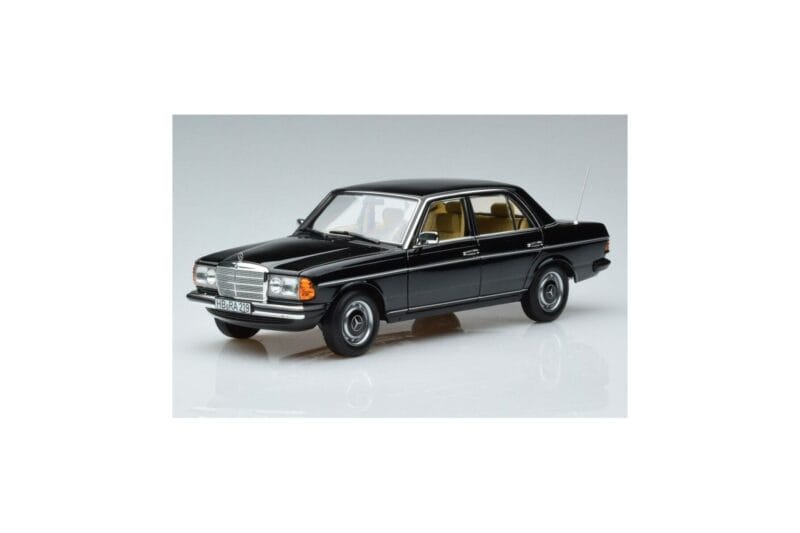
Few saloons of the late twentieth century earned the W123's reputation through sheer durability rather than outright performance. Between 1976 and 1985, Mercedes-Benz sold over 2.7 million examples worldwide — a figure that included police fleets, taxi companies, and heads of state in equal measure. The 230E variant, introduced in 1980 with Bosch K-Jetronic fuel injection replacing the carburetted 230's setup, added refinement to a platform already regarded as the benchmark for executive saloon engineering. Norev's 1:18 diecast model of this W123 captures the 1980 specification as a Limited Edition piece, bringing a quietly significant era of Mercedes-Benz production into display-case scale.
The W123 arrived as the successor to the W114/W115 series and immediately set a new standard for what a European executive saloon could be. Bruno Sacco's clean lines — restrained by the baroque excesses common to the era — aged better than almost any contemporary design. The 230E's 2.3-litre inline-four produced around 136 horsepower, but outright pace was never the point. Mercedes engineers focused instead on the body's exceptional torsional rigidity, the over-engineered suspension geometry, and the kind of paint and rustproofing processes that allowed W123s to accumulate mileages that would destroy less carefully built rivals.
By 1980, when this specific variant entered production, the W123 had already become the default choice for West German taxi operators — a demanding environment that destroyed lesser vehicles within two or three years. Many of these taxi examples routinely surpassed 500,000 kilometres before engine rebuilds were required. That durability narrative became part of the car's identity and explains why W123s survive in disproportionate numbers today, commanding genuine collector interest in the UK classic car market where structural integrity matters as much as sporting provenance.
The 230E also represents a transitional moment in Mercedes powertrain development. Fuel injection across the entire M115 engine range signalled the direction of travel for the 1980s, and this W123 variant served as the last evolution of the generation before the W124 replaced it in 1985 — a successor that borrowed heavily from the W123's engineering philosophy while adding a more aerodynamic body. Collectors who track Mercedes development from the Ponton era through to the modern S-Class find the W123 an essential chapter in that story.
Norev, the Lyon-based manufacturer with decades of experience producing European saloons and sports cars in zinc alloy diecast, suits this subject well. The W123's straight-edged body panels and large glass areas — characteristics of late-1970s German design — translate more naturally to diecast tooling than the compound curves of Italian sports cars, which often expose the medium's limitations at panel transitions. Norev's W123 features the opening doors, bonnet, and boot that define the 1:18 diecast experience, allowing close examination of the engine bay detail and the saloon's period interior.
At roughly 25 centimetres in length, the 1:18 scale provides sufficient size to read the subtle chrome detailing around the window surrounds and the characteristic W123 tail lamp clusters. The Limited Edition designation signals a controlled production run rather than the open-ended catalogue quantities of Norev's standard diecast releases — relevant for collectors who prioritise scarcity alongside accuracy. Paint finish reflects the restrained Mercedes palette of the early 1980s: the kind of silver-grey or tobacco brown that period sales brochures from Stuttgart favoured, rather than the brighter colours associated with contemporary Italian or British competition.
Compared to OttOmobile or GT Spirit resin alternatives — neither of which has released a W123 in this scale — Norev's diecast occupies the practical middle ground: opening features that sealed resin cannot offer, combined with a price point that makes the W123 accessible alongside other Norev Mercedes releases in a thematic display rather than as an isolated investment piece.
British collectors have a particular relationship with the W123 that goes beyond appreciation of German engineering. Throughout the 1980s and into the 1990s, the W123 saloon was a common sight on British roads — purchased new by professionals who valued reliability, or imported second-hand from Germany in the years when British buyers discovered that a used Mercedes often outlasted a new British Leyland product. That lived familiarity creates a different kind of collector connection than, say, a Ferrari 308 or a Lamborghini Countach. The W123 is a car many UK buyers remember their parents or grandparents owning, which adds a nostalgic dimension that purely exotic machinery cannot replicate.
In display terms, the W123 functions as an anchor piece for a serious modern classics collection rather than a hero car competing with Porsche 911s or Jaguar E-Types for shelf prominence. Positioned alongside a W126 S-Class, a W201 190E 2.3-16 — the Cosworth-developed homologation saloon that shares the W123's era — or a W124 500E, it maps a decade of Mercedes-Benz saloon development with a coherence that more varied collections cannot achieve. At Goodwood Revival events, where the W123's production years align with the Revival's period of coverage, the saloon's clean design reads well in period context alongside British and European contemporaries.
The Limited Edition run reinforces a collecting calculus familiar to UK buyers who frequent Kempton Park or Sandown Park swapmeets: standard production diecast is always available, but editions produced in finite quantities become progressively harder to source at retail price once they sell through. For a subject like the W123 — which has a dedicated following among Mercedes historians and everyday classic enthusiasts alike — the combination of Norev's reliable diecast quality and the controlled edition size makes this a sensible acquisition for anyone building a comprehensive 1980s European saloon display.